From RBAC to ABAC (to ReBAC): How Access Control Models Evolve
The one insight that makes the whole migration make sense
A role is just a special case of an attribute.
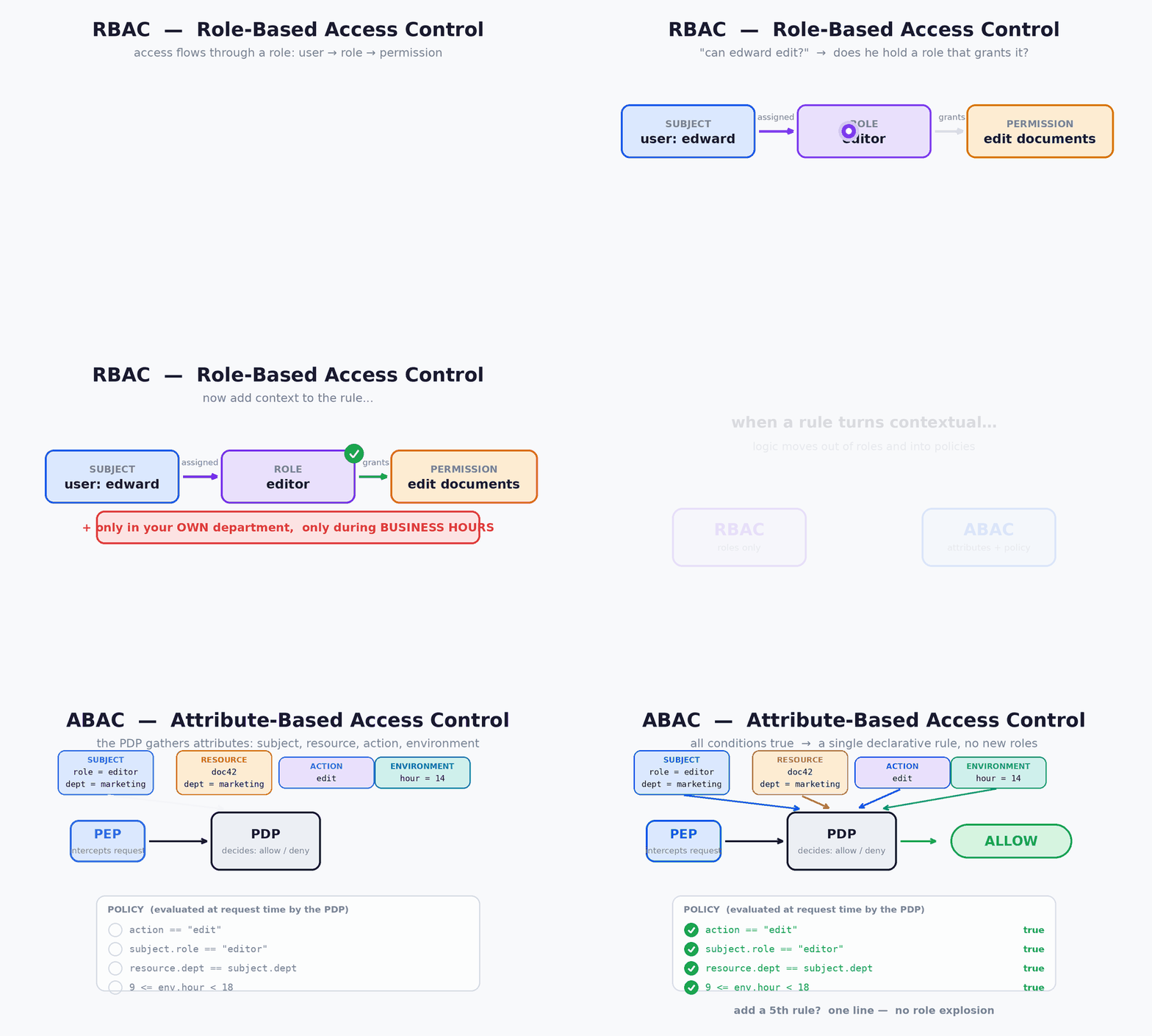
In pure RBAC the authorization question is narrow: "does this user hold a role that grants permission P?" The role is an indirection layer — it bundles a set of permissions, and users acquire those permissions by being assigned roles (user → role → permission).
ABAC keeps that idea but widens the lens. Instead of looking only at which roles you hold, a policy can evaluate arbitrary attributes of four things:
- the subject — role, department, clearance, manager, employment status
- the resource — owner, classification, project, sensitivity tag
- the action — read / write / approve
- the environment — time of day, IP, device posture, MFA state
Under that framing, RBAC is simply the degenerate form of ABAC where the only attribute anyone ever inspects is subject.role. That is exactly why the transition is gradual rather than a rewrite: you don't throw roles away, you demote them from being the entire model to being one attribute among many.
Why the pressure to migrate: role explosion
RBAC works beautifully until policies become contextual.
"Editors can edit" — fine. "Editors can edit, but only documents in their own department, only during business hours, only if the doc isn't confidential" — no longer expressible with roles alone.
To force contextual rules into a role model you start minting combinatorial roles: editor-marketing, editor-marketing-bizhours, editor-finance-nonconfidential, and so on. The role count grows multiplicatively with every new condition. That blow-up — role explosion — is the classic thing that pushes teams toward attributes. (Shown in the RBAC → ABAC animation below.)
The gradual path, in three steps
- Pure RBAC — roles map directly to permissions.
- RBAC + attribute constraints — keep roles as the coarse backbone, then layer attribute conditions on top:
role == editor AND resource.department == subject.department. Most production systems live here permanently. AWS IAM is the canonical hybrid: roles and policies (the RBAC-ish part) plus condition keys and resource tags (the ABAC part). - Full ABAC — the role, if it survives at all, is just another attribute; all decision logic lives in policies evaluated at request time.
So the "replacement" is really the slow migration of decision logic out of role definitions and into attribute-based policy rules — rarely a big-bang cutover.
Implementation: two genuinely different problems
RBAC is a data-model problem
You have tables — users, roles, permissions — and the join tables user_roles and role_permissions. An access check is a set-membership test / JOIN: fast, cacheable, precomputable, and static. A pleasant side effect: the reverse question "who can access resource X?" is cheap, because you just walk the tables.
ABAC is a policy-evaluation problem
The NIST reference model splits the system into four cooperating pieces:
| Component | Role |
|---|---|
| PEP — Policy Enforcement Point | sits in front of the resource, intercepts the request |
| PDP — Policy Decision Point | evaluates policies, returns allow / deny (sometimes with obligations, e.g. "allow but log") |
| PIP — Policy Information Point | supplies the attributes the PDP needs |
| PAP — Policy Administration Point | where policies are authored |
At request time you gather the attribute context, hand it to the PDP, and it runs the policies. The policy is a boolean function over attributes, not a table lookup. (Shown in the second half of the RBAC → ABAC animation above.)
Common policy languages:
- XACML — the original; XML; heavyweight.
- Rego / Open Policy Agent (OPA) — the popular modern choice, usually run as a sidecar PDP.
- Cedar — AWS's newer language, behind Verified Permissions.
The tradeoff is real. ABAC buys fine-grained, context-aware control without role explosion — but it costs you auditability and simplicity. "Who can access this resource?" becomes an expensive reverse query: there's no table holding the answer, so you may have to enumerate subjects and evaluate policies against each. Large policy sets are harder to test and reason about, and every attribute a policy needs must actually be available at request time (latency plus a PIP to source it).
The third model hiding in the examples: ReBAC
Two very common "roles" aren't cleanly RBAC at all: "project member" and "groups he belongs to." These are inherently relational — they depend on the relationship between a specific user and a specific resource instance, not on a global role. Expressing them in ABAC is awkward (you carry a subject.member_of list and a resource.project_id and check for intersection).
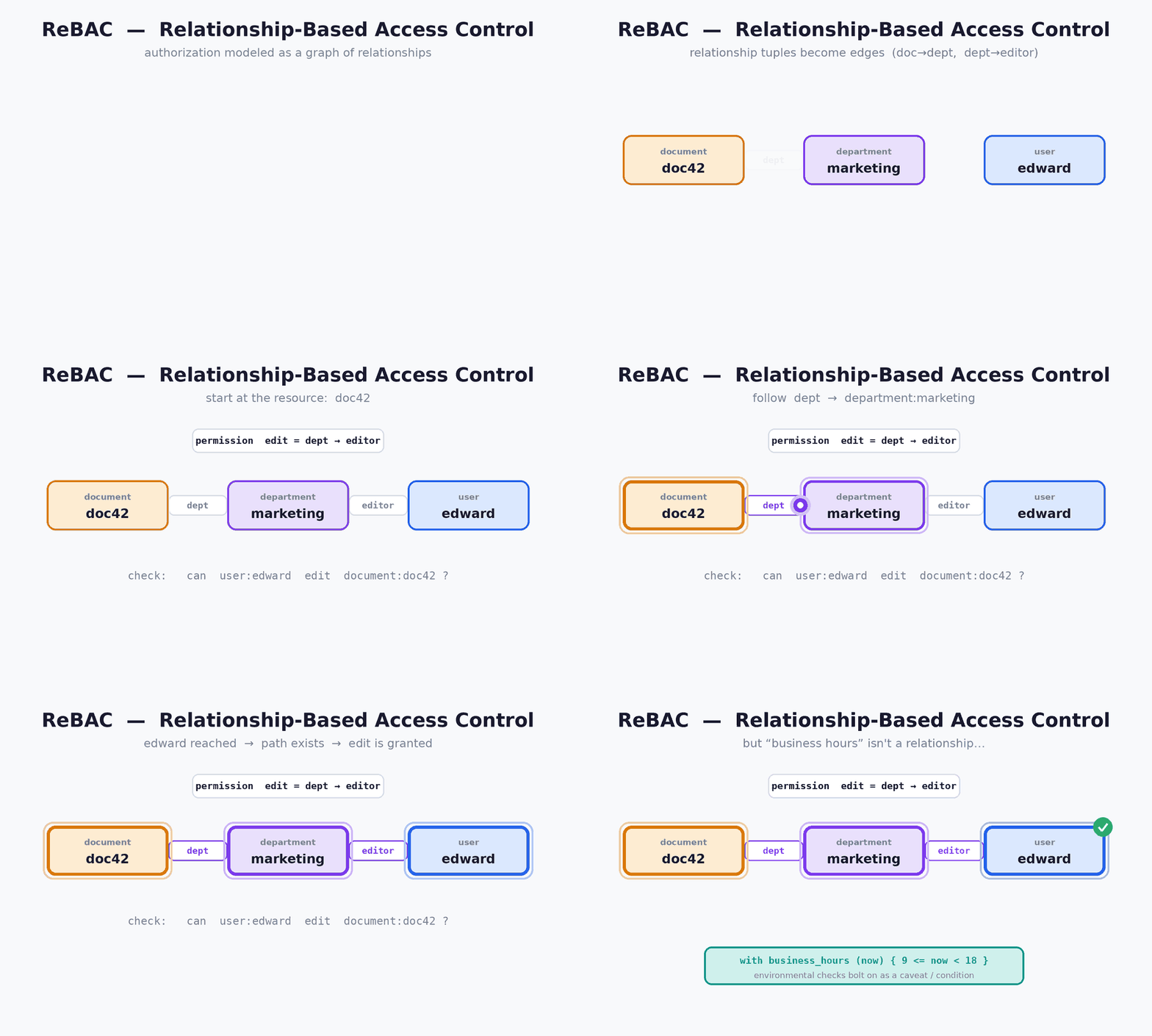
That awkwardness is what ReBAC — Relationship-Based Access Control exists to solve. It models authorization as a graph of relationships and answers questions by traversing that graph:
user:edward --member-of--> project:foo --owns--> doc:bar"Can edward view doc:bar?" becomes a reachability query over that graph. The canonical design is Google's Zanzibar; open implementations include SpiceDB, OpenFGA, and Ory Keto. If a lot of your rules take the shape "X is a member / owner / parent of Y," ReBAC often fits better than either RBAC or ABAC.
One rule, three models
To make the differences concrete, here is a single rule expressed in each model:
A user can edit a document if they're an editor, the doc is in their own department, and it's business hours.
RBAC — can't express it without leaking logic into code
A role is a static, global bundle — blind to the specific resource and to the environment. So you either explode the roles, or you keep a clean editor role and push the contextual checks into application code:
if user.has_role("editor") \
   and doc.department == user.department \
   and 9 <= now().hour < 18:
    allow()
Notice what happened: the moment a real rule appeared, two-thirds of the logic leaked out of RBAC into hand-written if statements scattered across the codebase. That leakage is the argument for ABAC — you're already doing attribute-based access control, just informally.
ABAC — the whole rule is one policy
Rego (Open Policy Agent):
package authz

default allow = false

allow {
    input.action == "edit"
    input.subject.role == "editor"
    input.resource.department == input.subject.department
    input.time.hour >= 9
    input.time.hour < 18
}
The request handed to the PDP carries the full context:
{
  "subject":  { "role": "editor", "department": "marketing" },
  "action":   "edit",
  "resource": { "id": "doc:42", "department": "marketing" },
  "time":     { "hour": 14 }
}
Cedar (AWS) — more structured about the principal / action / resource triple:
permit (
    principal,
    action == Action::"edit",
    resource
)
when {
    principal.role == "editor" &&
    resource.department == principal.department &&
    context.hour >= 9 && context.hour < 18
};
All three conditions — role, ownership, time — live in one declarative place. Adding a fourth ("…and the doc isn't classified") is a one-line edit, not a new role.
ReBAC — "own department" becomes an edge, not a comparison
SpiceDB / OpenFGA-style schema:
definition user {}

definition department {
    relation editor: user
}

definition document {
    relation dept: department
    permission edit = dept->editor
}
Relationship tuples (the facts that populate the graph):
department:marketing#editor@user:edward
document:doc42#dept@department:marketing
The check document:doc42#edit@user:edward returns true by traversal: doc42's dept is marketing, edward is an editor of marketing, so edit is granted. There's no "does edward's department equal the doc's department" comparison anywhere — the relationship replaces the attribute match.
But note what's missing: business hours. Time-of-day is a pure environmental attribute — it isn't a relationship between two entities, so it has no natural home in a relationship graph. This is ReBAC's genuine weak spot, and systems bolt it on with a side mechanism — SpiceDB calls them caveats, OpenFGA calls them conditions:
caveat business_hours(now int) {
    now >= 9 && now < 18
}

definition document {
    relation dept: department
    permission edit = dept->editor with business_hours
}
You pass {now: 14} as context at check time. So even ReBAC reaches for ABAC-style attribute evaluation the moment an environmental condition appears — a nice illustration that these models are points on a spectrum, not rivals.
How the one rule sorts across the three models
| Rule clause | RBAC | ABAC | ReBAC |
|---|---|---|---|
is an editor | ✅ native (a role) | ✅ native (an attribute) | ✅ native (a relation) |
| own department | ❌ needs role explosion / app code | ✅ attribute equality | ✅✅ most natural — an edge |
| business hours | ❌ can't express at all | ✅ native | ⚠️ needs a caveat / condition bolt-on |
Practical takeaway
Mature systems are almost always hybrids. AWS is the clearest example — IAM roles (RBAC), IAM policy conditions and tags (ABAC), and Cedar / Verified Permissions for finer policy — all in one stack.
A decent per-rule heuristic:
- If a rule reads "X has role R" → use roles (RBAC).
- If it reads "X's attribute matches Y's attribute" or "the environment is Z" → use ABAC.
- If it reads "X is a member / owner / parent of Y" → reach for ReBAC.
Most real applications contain all three kinds of rules — so you pick the model per rule, rather than converting the whole system to a single one.
References & further reading
Foundational models & standards
- RBAC — D.F. Ferraiolo & D.R. Kuhn, Role-Based Access Control (1992); formalized as the NIST RBAC model and standardized as ANSI/INCITS 359 (2004, revised 2012). NIST project page: https://csrc.nist.gov/projects/role-based-access-control
- ABAC — V.C. Hu et al., NIST SP 800-162: Guide to Attribute Based Access Control (ABAC) Definition and Considerations (2014, updated 2019). This is the source of the subject/resource/action/environment definition and the PEP / PDP / PIP / PAP component model. https://csrc.nist.gov/pubs/sp/800/162/upd2/final · PDF: https://nvlpubs.nist.gov/nistpubs/specialpublications/nist.sp.800-162.pdf
- XACML — eXtensible Access Control Markup Language (XACML) Version 3.0, OASIS Standard (22 Jan 2013; plus Errata 01, 2017). https://www.oasis-open.org/standard/xacmlv3-0/ · Core spec: https://docs.oasis-open.org/xacml/3.0/xacml-3.0-core-spec-os-en.html
- ReBAC / Zanzibar — R. Pang, R. Cáceres, M. Burrows, et al., Zanzibar: Google's Consistent, Global Authorization System, USENIX ATC '19 (2019). https://www.usenix.org/conference/atc19/presentation/pang · Annotated edition: https://authzed.com/zanzibar
ABAC policy engines & languages
- Open Policy Agent (OPA) / Rego — CNCF graduated, general-purpose policy engine; Rego is its declarative policy language. https://www.openpolicyagent.org/
- Cedar — open-source policy language (Apache 2.0) from AWS. https://www.cedarpolicy.com/ · Reference docs: https://docs.cedarpolicy.com/
- Amazon Verified Permissions — managed authorization service built on Cedar. https://aws.amazon.com/verified-permissions/
- AWS IAM ABAC — attribute-based access control implemented via tags and condition keys; the canonical RBAC + ABAC hybrid referenced above. https://docs.aws.amazon.com/IAM/latest/UserGuide/introduction_attribute-based-access-control.html
ReBAC implementations (Zanzibar-style)
- SpiceDB (AuthZed) — open-source Zanzibar implementation; source of the caveats mechanism. https://github.com/authzed/spicedb
- OpenFGA (CNCF incubating; originally Auth0/Okta) — Zanzibar-inspired engine; source of the conditions mechanism. https://openfga.dev/
- Ory Keto — the first open-source implementation of the Zanzibar model. https://github.com/ory/keto
Sources retrieved July 2026; product and standards pages may have been updated since.
react & discuss
EOF · cd ~